How to Choose a Rug: The Decisions That Actually Matter
An interior architect on why size is always the problem, and how to choose the right material for the right room
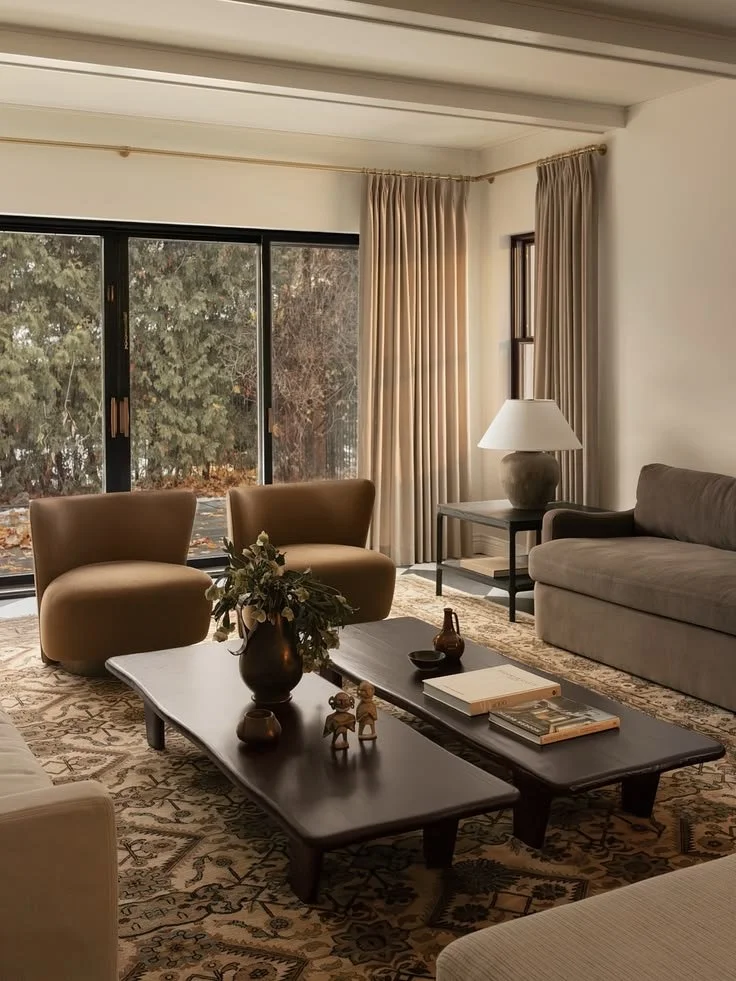
People choose rugs the way they choose art — emotionally, visually, often in isolation from the room they're going into. They find something beautiful, they think about whether the colours work, and they order it. Then it arrives and something is off. Usually it's the size. Sometimes it's the pile. Occasionally it's a material that looked right on screen but behaves completely differently underfoot.
The rug is one of the most architecturally significant decisions in a room. It defines the spatial zone that the furniture inhabits. It anchors what would otherwise float. It introduces warmth, sound absorption, texture — all at once. Getting it right changes a room more than almost anything else. Getting it wrong is very difficult to ignore.
Here's how I make the decision.
1. The rug is a spatial decision before it's a decorative one
Before considering pattern or material or colour, consider what the rug needs to do in the room architecturally. A rug defines a zone. It tells a room where one conversation ends and another begins. In an open-plan space it can separate a dining area from a sitting area without a wall. In a bedroom it tells the floor where the sleeping space lives. In a hallway it creates a arrival sequence.
This spatial function should drive the sizing decision, not afterthought. Ask: what furniture group does this rug need to contain? The answer gives you the minimum dimensions. Everything else — material, pattern, colour — is chosen within that framework.
2. Size — the most important call you'll make
Almost every rug that doesn't work in a room is too small. This is so consistent it has become a reliable observation: the rug that looked generous in the shop sits in the room and looks like a mat.
The rule for the living room: at minimum, the front legs of every seating piece should sit on the rug. Ideally, all four legs of each piece rest on it. A rug that only the coffee table sits on is doing nothing for the room — it looks like it was placed to protect the floor rather than to define the space.
In practical terms, most living rooms need a rug of at least 200x300cm. A 160x230cm rug — the size most people choose when cautious — will almost always feel too small once the furniture is placed. If in doubt, go larger. A rug can be too small for a room. A rug is very rarely too large.
For bedrooms: the rug should extend at least 50–60cm beyond each side of the bed. You step out in the morning and land on it. A rug that only peeks out from beneath the bed frame is visually lost — the proportion between rug and room collapses.
For dining rooms: allow at least 60cm from the edge of the table to the edge of the rug on all sides. Chairs need to be able to pull out and remain on the rug. A 8x10 or 9x12 foot rug (roughly 240x300cm or 270x360cm) works for most dining tables.
3. Material — what each one is actually for
Wool is the most considered choice for any principal living space. It has natural resilience — it springs back under foot traffic in a way synthetic fibres don't — and it ages well, developing a softness and patina over years rather than breaking down. Wool rugs absorb sound, regulate temperature slightly, and photograph beautifully. The trade-off: cost, and an initial shedding period in the first months that subsides with regular vacuuming. For a living room or bedroom where the rug will be lived with daily for years, wool is the investment worth making.
Jute, sisal and seagrass are natural fibres with an earthy, organic texture that works particularly well in rooms that are already warm in tone — linen, timber, raw plaster. Jute is the softest of the three and the most relaxed in character. Sisal is more structured and holds up better in higher-traffic areas. Seagrass is naturally stain-resistant. The limitation shared by all three: they don't respond well to moisture and are difficult to deep clean, which makes them less suitable for dining rooms or anywhere spills are likely. They excel as a base layer in a layered rug arrangement, or as the primary rug in a room that's drier and calmer in use.
Vintage and hand-knotted rugs are in a category of their own. A genuine hand-knotted wool rug — Persian, Moroccan, Turkish — has a density and irregularity that machine-made rugs don't replicate. The pattern sits differently; the pile has depth. They're also durable in a way that surprises people: a well-made antique rug has already lasted decades and will continue to. From a design perspective, a vintage rug can do more work in a room than almost any other single piece — it introduces colour, history, and material intelligence at once. They are worth searching for, and worth spending on.
Synthetic rugs (polyester, polypropylene, PET) have improved significantly and serve a real purpose in the right rooms. For high-traffic areas — hallways, children's rooms, outdoor-adjacent spaces — a well-made synthetic flatweave is practical, easy to maintain, and can be genuinely handsome. The limitation is in the pile: under a hand, synthetic fibres don't have the warmth or resilience of natural ones, and this eventually reads in the room. In a principal room where the rug will be noticed daily, natural materials are worth prioritising. Where practicality is the overriding concern, a good synthetic is a rational choice.
4. Pile height — the detail most people overlook
Pile height affects how a rug behaves in a room as much as its material does. A high-pile rug — anything over about 2cm — is soft underfoot and reads as warm and cosy. It's well suited to bedrooms and sitting rooms where comfort is the priority. The drawback is that furniture legs sink into high pile, which can make pieces look unstable, and high pile is harder to vacuum thoroughly.
A low-pile or flatweave rug is easier to maintain, more suitable under dining chairs and in high-traffic areas, and reads as more architectural — crisper, more defined. Flatweave rugs in particular work well in layered arrangements, as the base beneath a smaller, higher-pile piece.
Medium pile (around 1–1.5cm) is the most versatile and the safest choice if you're uncertain.
5. Pattern — a guide for the hesitant
The instinct when choosing a patterned rug is often to wonder whether it will be too much. In practice, a rug with a strong pattern in a room with plain furniture and walls is usually exactly right — it's the thing that gives the room its character without the room feeling overdone. The combination that rarely works is pattern on pattern: a patterned rug competing with patterned cushions, curtains, or wallpaper. One pattern per room, used confidently, is almost always better than several used tentatively.
Geometric patterns — stripes, diamonds, abstract — tend to read as contemporary. Botanical and traditional patterns, particularly in vintage rugs, read as considered and personal. Both are valid; the choice belongs to the tone of the room.
Colour within a pattern is often less bold in situ than it appears on screen. A rug with rich terracotta and dark indigo that looks dramatic on a white website background will settle considerably once it's on a warm wooden floor surrounded by furniture.
6. Layering
Layering two rugs — a larger, simpler base beneath a smaller, more characterful piece — is one of the most useful techniques in a room that needs warmth and texture but can't find a single rug that does everything.
The principle is straightforward: the base layer is neutral, natural, and large enough to define the zone. A jute or flatweave rug in a warm neutral works for almost any base. The top layer is smaller, more considered, more personal — a vintage piece, a hand-knotted rug with pattern, something with pile and presence. The combination of two surfaces and two textures adds depth that a single rug rarely achieves.
The one rule: the base should be flat or low pile. A high-pile base layer beneath anything is impractical and visually restless.