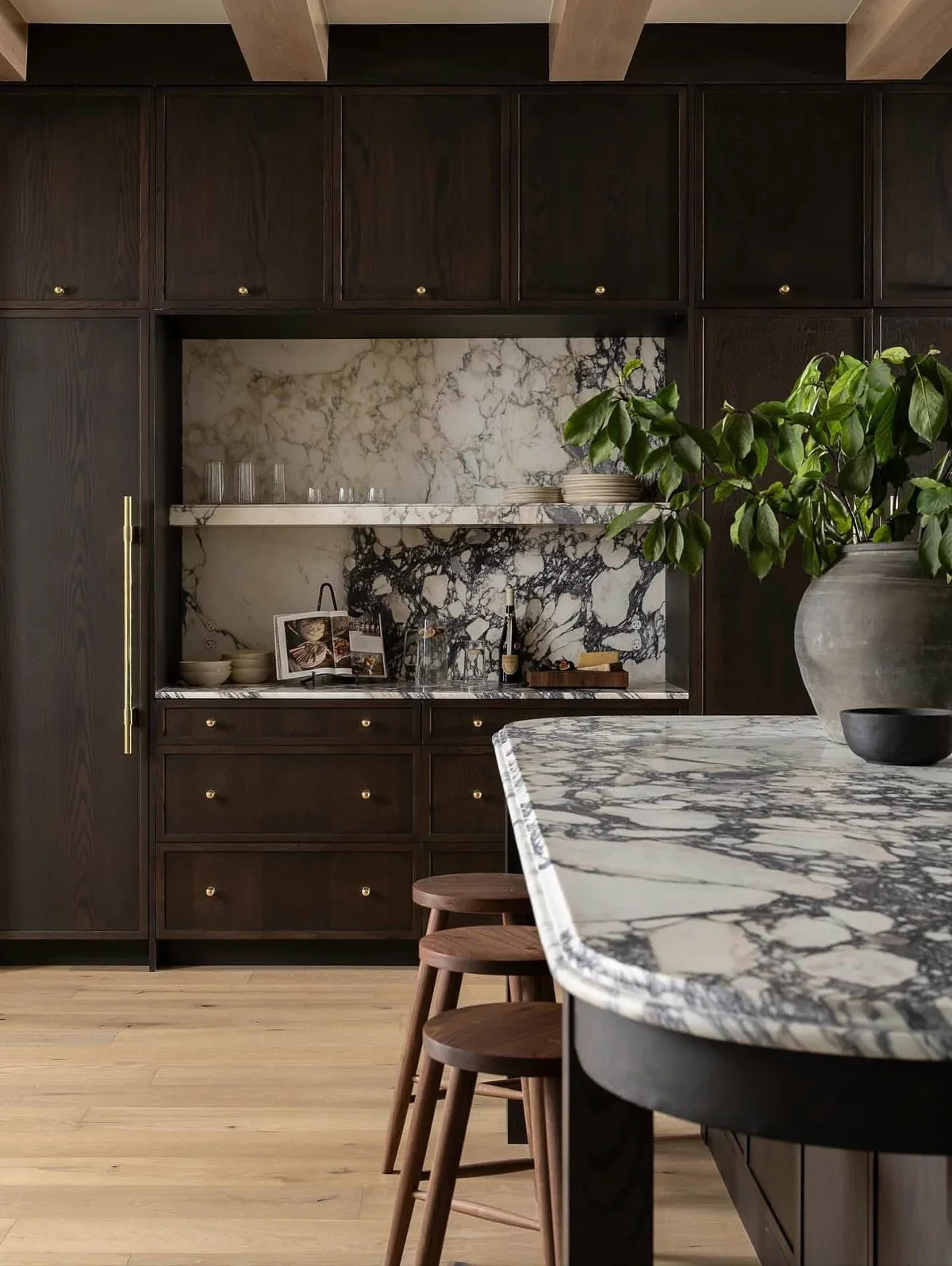
Everything in Its Place: How to Organise a Kitchen That Actually Works
An interior architect on the details most people never think to ask for — and why the difference between a kitchen that functions beautifully and one that frustrates you daily is almost entirely in the specification
A kitchen can be beautiful and still fail you ten times a day. The worktops are right, the cabinetry is considered, the handles are exactly what you wanted — and yet every morning there's a small skirmish with a cupboard door swinging into your hip, a toaster you have to move to use, a kitchen roll sitting on the worktop because nobody designed a home for it. These aren't decorating problems. They're specification problems. And nearly all of them are easy to solve at build stage, at very little additional cost, if you know to ask.
This is the first in a series on organisation by room. The kitchen is where to start, because it's the room that accumulates the most friction — and the one where the right decisions make the biggest difference to daily life.
1. Drawers over doors — almost every time
The single piece of advice I give every kitchen client: specify drawers wherever your budget allows.
The reason is practical, not aesthetic. Drawers let you see everything at once. You open a drawer and the entire contents are visible from above — no reaching blindly into the back of a cabinet, no things lost for months behind other things. A deep lower cabinet with a hinged door is, in most cases, wasted space. You can access approximately the front third of it easily. The rest becomes a place where things go to disappear.
Replace those lower cabinets with drawers and the kitchen changes completely. Three deep drawers in the place of a base cabinet with shelves will hold more usable storage than the cabinet it replaced — because you can actually see and reach everything in them. The pots at the back of a lower cabinet are not accessible storage. They're archival storage with extra steps.
The objection I hear is cost. Drawers with proper drawer boxes and soft-close runners cost more than hinged doors. They do. But not dramatically more, particularly at build stage when you're already spending on the kitchen. And the difference in daily function is disproportionate to the cost difference. If there's one place in the specification to invest in the kitchen, this is it.
2. The appliance garage
A tall cabinet section with a pull-out or lift-up door — located on the worktop, with base storage below — that hides everything you use daily: coffee machine, toaster, kettle, blender. Close the door and the kitchen looks like nothing is happening. Open it and everything is exactly where you need it, without ever leaving the worktop.
Most people get the garage. Fewer remember to put power inside it.
This is the detail that makes the difference. A socket at the back of the appliance garage means your coffee machine lives permanently plugged in, in place. You open the door, press a button, close the door. No moving anything to reach a socket on the wall. No cables trailing across the worktop. The kitchen remains calm even when it's being used.
The lift-up door version works better than hinged for most people — it opens fully and stays out of the way while you're working, rather than swinging out into the room. Specify the door with a soft-close mechanism and a stay at the open position so it doesn't drop unexpectedly.
Position the garage near where the morning routine happens — close to where people make coffee, stand, prepare things. The garage should be convenient, not tucked into a corner because it fitted there in the plan.
3. A drawer that charges your devices
One of the highest-impact, lowest-cost details you can add to a kitchen island: a deep drawer with an integrated socket at the back.
Phones, tablets, keys, cables — all of them end up on the kitchen worktop because people put things down where they naturally pause, and the island is where people naturally pause. A charging drawer gives all of it a home. Everything goes in, everything charges, the lid closes, the worktop is clear. No cable trailing across the surface. No phone sitting face-up next to the chopping board.
The specification is straightforward: a standard deep drawer, a socket installed by your electrician at the back of the drawer cavity, a cable management grommet if needed. Some kitchen manufacturers offer this as a fitted option; others will spec it on request. It is not an expensive addition. It is one you will use every single day.
Specify it at the point in the island where people naturally stop and put things down — usually closest to the main entry into the kitchen, or the end nearest the seating area. Location matters as much as having it at all.
4. The kitchen roll pull-out
Quiet detail. You only miss it when it's not there.
A narrow pull-out — often built between the oven column and an adjacent cabinet, using a gap that would otherwise be wasted — holds your kitchen roll vertically, entirely integrated. The roll is accessible from the front, tears off cleanly, and then disappears back into the cabinetry. No holder mounted on the wall. No roll sitting on a shelf or leaning against the splashback. No debate about where it lives.
The width required is approximately 15cm. This is a gap that exists in most kitchen layouts and is usually either ignored or filled with a filler panel. Specifying a pull-out in its place costs very little and solves a genuinely annoying daily problem. If your kitchen is already built, some aftermarket versions can be retrofitted into existing cabinet runs — worth looking at if the gap is there.
5. Pantry: decant, zone, label
The three-step pantry system that makes the difference between a pantry that requires maintenance and one that stays organised without effort.
Decant. Remove everything from its original packaging. Pasta out of the cardboard box, grains out of the paper bag, baking ingredients out of whatever they arrived in. Store in clear, uniform containers — glass or BPA-free with tight-fitting lids. The visual calm this creates is immediate. But the more important effect is practical: when everything is in a container you can see through, you always know what you have and roughly how much of it. You stop buying duplicates because you can see you already have oats. You stop running out of things because you can see the container is almost empty.
Zone. Group by category, not by size or container shape. Baking ingredients together: flour, sugar, baking powder, vanilla. Grains together: rice, pasta, oats, lentils. Oils and vinegars together. Snacks together. The logic should be the logic of how you cook, not the logic of what fits where. When you need something, you go to a zone, not to a shelf-by-shelf search.
Label. Everything that goes into a uniform container gets labelled — not just for identification, but because it removes the half-second cognitive friction of checking what's in every container. A labelled pantry is quicker to navigate, easier for other people to use, and easier to maintain because putting things away correctly requires no thought.
The system lasts because it's easy to maintain. Everything has a place. Putting things back is as quick as taking them out.
6. Give every drawer a specific job
The drawer that holds everything holds nothing well. The principle of single-purpose drawers is the difference between a kitchen that is organised and one that functions as organised.
A plate drawer with a wooden grid insert — plates slot in individually and are held upright, so they can't stack, can't chip, and can be retrieved without lifting the whole stack. You take the plate you want directly. The grid is a standard insert available from most kitchen storage suppliers and can be specified at build stage or added later.
A shallow spice drawer — bottles laid flat, labels facing up, so every label is readable at a glance without picking anything up. Specify the drawer at a height of approximately 6–7cm internally. All spice bottles fit. All labels are visible. No reaching to the back of a tall cabinet to find the one you need.
A dedicated lid drawer — pan lids are the object most likely to be stored without a system and retrieved with frustration. A drawer with a simple vertical divider lets lids stand upright and be accessed immediately. One drawer. One job. Eliminates a specific and recurring daily irritation.
A vegetable drawer with divided sections — root vegetables, alliums, squash, all separated. Not an aesthetic decision: different vegetables store better in different conditions and separating them extends their life. The divided sections also mean you can see what you have without rummaging.
None of these inserts are expensive. All of them make the kitchen feel like it was designed for the way you actually cook — because it was.
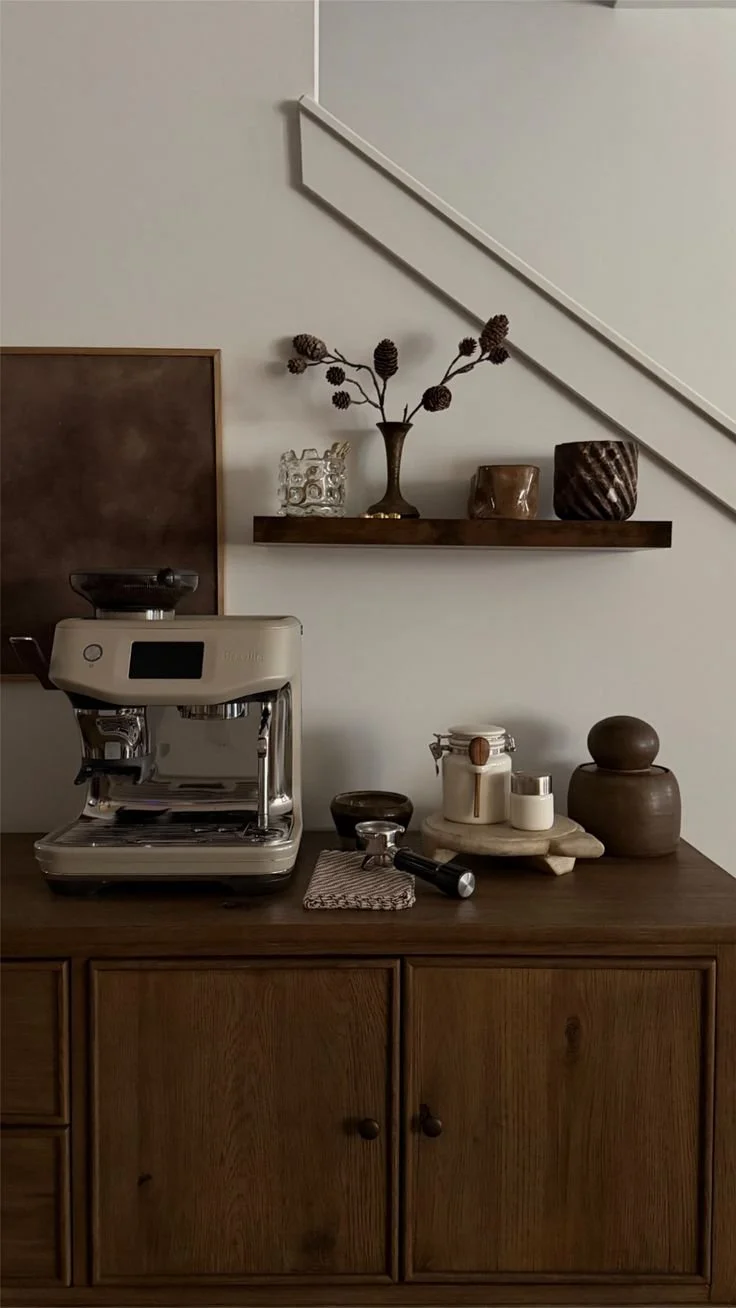
7. The coffee corner
This one sits somewhere between function and feeling.
The morning ritual is among the most repeated acts in a household. Coffee, every single day, multiple times. It deserves to feel considered rather than improvised. An appliance on the worktop, capsules in a bag nearby, cups wherever they fit — this is how most kitchens handle it, and it reads as something that wasn't designed, just accumulated.
The coffee corner is a small designated zone: an open shelf at eye level, two or three cups displayed rather than stacked in a cabinet, a small marble or stone tray for capsules or a grinder. The machine below, either tucked into the appliance garage or given its own niche. The socket hidden. The cables absent.
What you're creating is a ritual with a home. The coffee corner doesn't need to be large — a single shelf above a 60cm section of worktop is enough. It needs to be considered: deliberately positioned, deliberately styled, and designed so that everything required for the morning ritual is within arm's reach without opening a single door.
Small shelf. Big difference.
None of these details are expensive to specify at build stage. They become expensive when you try to retrofit them — when the kitchen is already built, when the electrician has to come back, when the cabinet has to be remade. The difference is knowing to ask for them before work begins.
A kitchen that functions beautifully isn't a question of budget. It's a question of decisions made at the right moment, with the right information.